
Oriented Strand Board (OSB) - a smart, sustainable board choice
It's a stronger, more stable foundation for doors, shelves, and panels. is an engineered wood panel made from precisely arranged timber strands bonded under heat and pressure to create a strong, stable structural board.
While many people associate OSB with construction and structural applications, high-quality low-emission OSB is also an excellent material for premium cabinetry—particularly when used as the structural core beneath real wood veneers.
At Sustique, we value materials that combine performance, longevity, efficient use of resources, and healthier indoor environments. When correctly specified, OSB performs strongly across all of these areas.
Structural Strength
OSB is engineered for strength.
Its layered strand construction gives it excellent load-bearing capability and structural rigidity, making it highly suitable for cabinet doors, shelving, and structural furniture applications.
Unlike weaker low-density boards, OSB is designed to perform under load.
Dimensional Stability
Cabinetry needs to stay true over time.
High-quality OSB offers strong dimensional stability, helping reduce movement, twisting, or distortion when compared with lower-grade alternatives.
This matters in kitchens, where heat, humidity, and daily use can place significant demands on materials.
Stable cabinetry helps doors align correctly, drawers operate smoothly, and worktops remain properly supported.
Strong Screw-Holding Performance
A cabinet is only as reliable as the fixings that hold it together.
OSB offers excellent screw-holding strength due to its structural composition, making it a robust material for hinges, drawer runners, connectors, and assembly fixings.
This contributes to long-term durability and serviceability.
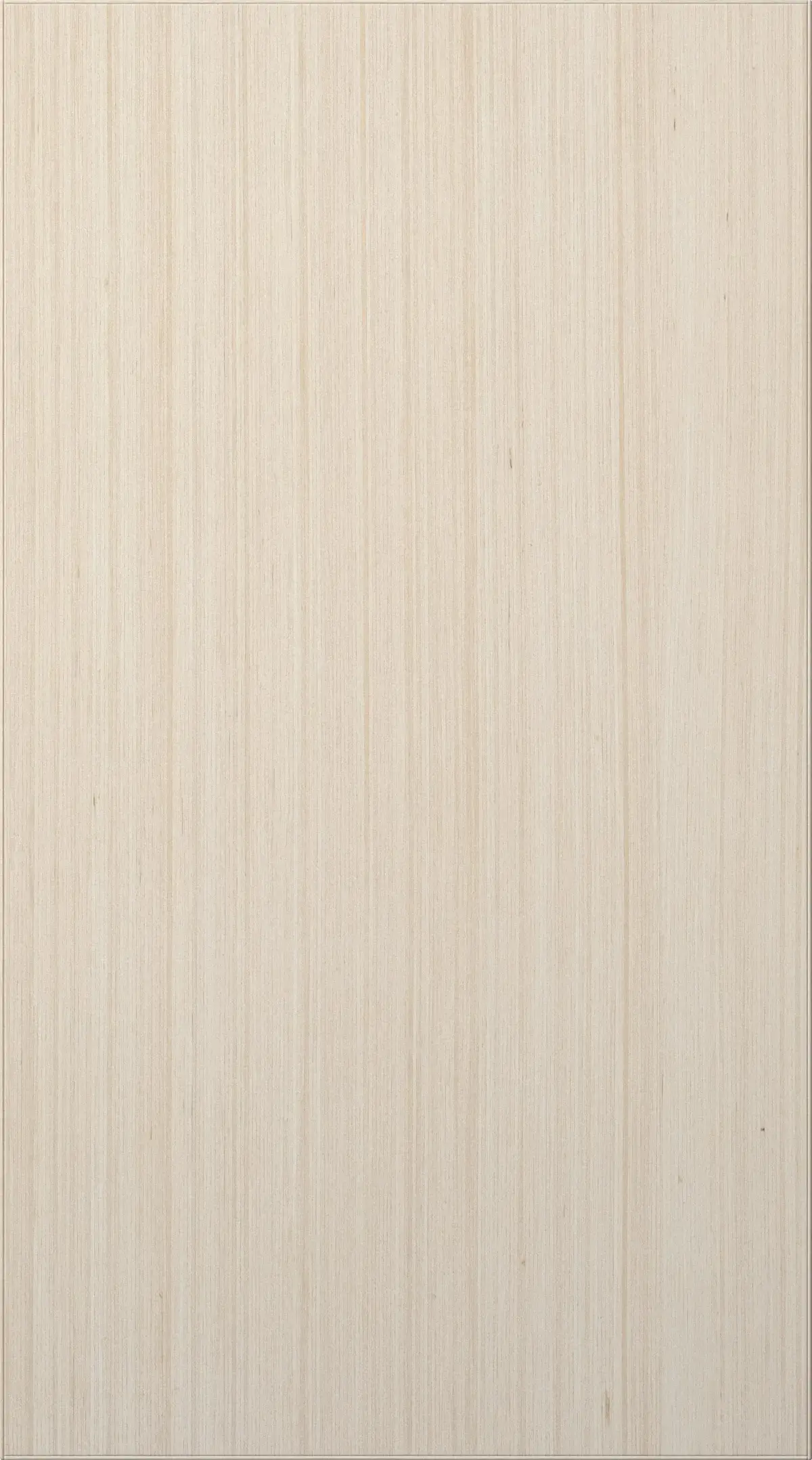
An Excellent Base for Wood Veneers
Real wood veneer offers the warmth and beauty of natural timber while using far less solid wood.
But veneer performance depends heavily on the substrate beneath it.
A good substrate should be:
- structurally stable
- resistant to movement
- consistent in density
- capable of maintaining adhesion over time
OSB performs strongly in these areas.
Its engineered structure provides a stable foundation that helps support high-quality veneered finishes, reducing the risk of warping, cracking, or premature failure associated with poor substrate choice.
OSB vs MDF
MDF (Medium Density Fibreboard) is widely used in the kitchen industry, but it has limitations.
Compared with MDF, OSB offers:
- greater structural strength
- better screw-holding performance
- improved moisture tolerance
- lower risk of edge damage
- more efficient use of timber resources
MDF can perform adequately in many applications, but it is denser, heavier, and less structurally robust.
It also relies on formaldehyde-based binders, making emissions performance an important consideration unless low-emission certified variants are used. There are exceptions that don't use added formaldehyde, but they are more expensive and still don't address the question of recycled and recyclable content.
OSB vs Chipboard / Particleboard
Chipboard is widely used in conventional kitchen cabinetry because it is cost-effective.
However, it is ess structurally capable than OSB.
Compared with standard chipboard, OSB offers:
- improved rigidity
- stronger edge integrity
- better screw retention
- better resistance to swelling
- more predictable structural performance
Not all engineered boards are equal.
Specification matters.
OSB vs Plywood
Plywood has a strong reputation, and in many applications it performs extremely well.
However, quality varies widely.
Compared with many plywood products, OSB offers:
- more consistent structural performance
- fewer void-related issues
- better cost efficiency
- more efficient use of smaller timber resources
High-quality birch ply remains an excellent premium material, but it comes at significantly higher cost.
For many cabinetry applications, well-specified OSB provides an excellent balance of performance, consistency, and sustainability.
Sustainability Considerations
OSB makes efficient use of timber resources.
Rather than relying on large sections of high-grade timber, it uses smaller fast-growing wood strands arranged for maximum structural performance.
This helps reduce waste and improves raw material efficiency.
As with any engineered wood product, environmental performance depends on:
- timber sourcing
- resin chemistry
- manufacturing standards
- emissions certification
At Sustique, we believe specification matters more than assumptions.
The Sustique View
Material choices should be judged on performance, longevity, emissions profile, and resource efficiency—not just familiarity.
OSB may not have the polished image of some alternative materials, but when properly specified, it is a technically capable, structurally robust, and resource-efficient choice for quality cabinetry.